

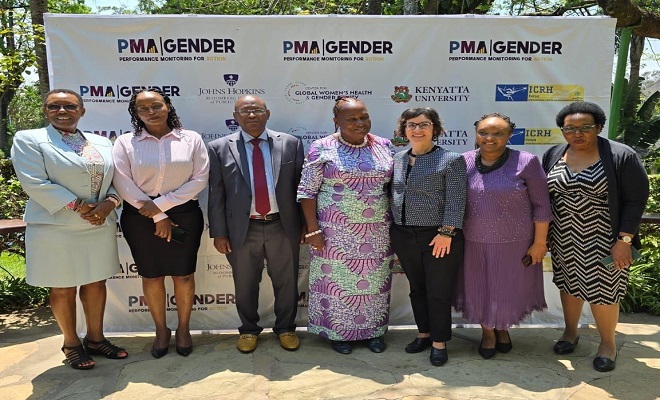
During the launch, Prof. Violet Nanyu, Board Member of the International Centre for Reproductive Health Kenya (ICRHK), delivered a powerful message that resonated with all in attendance:
“We are facing gender norms to fight GBV. A world where everyone is free from the threats of violence and can achieve their full potential is the world we are working towards.”
Prof. Nanyu’s words serve as a reminder of the central mission of PMA Agile—to create a world where violence, particularly against women and girls, is not tolerated, and where every individual has the opportunity to thrive. PMA Agile’s collaborative leadership includes ICRHK (Mary Thiongo, Prof Peter Gichangi), Kenyatta University Women’s Economic Empowerment Hub (Grace Ngare, Regina Mwatha), and Johns Hopkins Bloomberg School of Public Health/ Center for Global Women’s Health and Gender Equity (Prof Michele Decker).
The Alarming Reality of GBV and Gaps in Policy Confidence
GBV remains a widespread issue in Kenya, with deeply ingrained cultural norms contributing to the persistence of violence, especially against women and girls. According to the 2022 Kenya Demographic and Health Survey (KDHS), 45% of women aged 15–49 have experienced either physical or sexual violence in their lifetime. Moreover, Prof. Ann Kihara shared an alarming statistic from Kenyatta National Hospital’s GBV center in her remarks: 75% of those seeking help are women and girls, many of whom are facing severe public health consequences. These figures are a stark reminder of the ongoing crisis.
While Kenya has made strides in establishing a policy framework to combat GBV, gaps in public confidence in the justice system remain a significant challenge, “if people are unsure, they are not going to report to police.” This underscores the need to not only improve policy but also ensure that communities trust in the systems meant to protect them. Building confidence in access to justice is critical to encouraging survivors to come forward and seek help.
The PMA Agile women’s data launch brought together key stakeholders, from grassroots organizations to governmental bodies, all committed to breaking the cycle of violence through evidence-informed action. The survey data demonstrate persistent intimate partner violence in the four counties (27%, past year, among partnered women). Critically, the team presented estimates on forms of GBV for which no national data currently exist, including economic abuse (22%, past year, among partnered women), technology-facilitated gender-based violence (29.5%, past year), and sexual harassment (47.1%, past year). Helpseeking was relatively low, and actionable gaps were identified in confidence in the GBV response across police and health sectors. A robust discussion affirmed commitment to translating these gaps to policy. There is a clear need to strengthen systems for response – the laws criminalizing violence against women remain effectively inaccessible when confidence in police response is low and attitudes discourage intervention in cases of partner violence. Increasing confidence in police response and changing norms to enable helpseeking are actionable and represent meaningful metrics for change. Primary GBV prevention was also identified as a priority. As we reflect on the success of the event, it’s clear that this was just the beginning. The energy and passion in the room underscored the urgent need for continued collaboration, innovation, and advocacy in addressing GBV.
To bridge the gap in policy confidence, the PMA Agile initiative aims to work closely with communities to create awareness and provide education on the resources available to GBV survivors. Ensuring that survivors feel supported and secure in seeking help is essential for women’s safety and full economic participation.
Insights on Reproductive Health
GBV also intersects with broader reproductive health issues in Kenya. According to recent data, 40% of women of reproductive age are not using contraceptives, signaling a significant gap in family planning access and education. However, there is good news-90% of women are reporting the use of disposable sanitary products, showing progress in menstrual hygiene management. These findings reflect the mixed progress in addressing women’s health and underscore the need for continued efforts in sexual and reproductive health education.
Building a Safer, More Equal Future
PMA Agile’s approach goes beyond awareness; it focuses on action. From empowering local communities with cutting-edge data, to equipping healthcare providers, educators, and policymakers with the information needed to combat GBV, the project is paving the way for a future where everyone can live free from fear and violence.
We are particularly proud of the partnerships that were strengthened during the launch, all aimed at breaking down the societal norms that perpetuate violence. The PMA Agile team will continue to work closely with these stakeholders to ensure that the evidence presented translate into real, measurable progress.
Looking Ahead
As we move forward, PMA Agile remains committed to challenging harmful practices, raising awareness, and supporting survivors through high-quality actionable data. Through data-driven strategies, community engagement, and unwavering dedication, we will continue pushing the envelope in our efforts to end GBV and close gaps in reproductive health access.
The road to achieving a world free from violence and inequality is long, but with collective effort and sustained action, we can bring about lasting change.
We thank everyone who contributed to making the launch a success and look forward to sharing the progress we make as we continue to use these data to create meaningful change. As the femicide of Rebecca Cheptegei at the hands of her partner, and countless others without a similar spotlight illustrate – women’s lives depend on it. , we can build a future where everyone, regardless of gender, can reach their full potential.
